
£80 for Initial Consults & Assessment + Care Recommendations
Save £20 on all new patient consultations. Expires 1st of September.

Your spine is an incredible structure, one that supports you through every movement, every demand, every season of life. And yet, it’s something we rarely think about.
I will be honest, before I discovered chiropractic, I hadn’t thought about it at all. So, if you are in the same boat, I assure you that you’re not alone.
Unlike our teeth, which we see and care for daily, the spine sits quietly behind us. For most, it only becomes something we notice when something doesn’t feel quite right, often in the form of discomfort or pain.
Pain can feel sudden, inconvenient, and poorly timed. It often appears when life is already full. Have you found that? It may be just before a holiday, during a busy period, or when you feel you can least afford to slow down.
But in many cases, it isn’t truly sudden. It’s the result of small, repeated stresses building over time.
And if you take a moment to reflect, your body was probably already giving you subtle signals that it needed some attention.
That tension in the shoulders that just won’t go away, the headache that makes any noise seem ten times louder (especially if you live with a toddler!), or the niggle in the lower back that you notice whilst out walking.
You may have heard the phrase “the straw that broke the camel’s back.” The body is incredibly adaptable, but there comes a point where it begins to signal that something needs attention. Pain is one way the body communicates, a gentle (or sometimes not so gentle) nudge to pause and listen.
These messages are coordinated through your nervous system, the connection between your brain and your body via your spinal cord.
Your spine plays an important role here, helping to protect the spinal cord and support how your body moves and responds. When the spine and pelvis aren’t moving as freely as they could, it can influence how your body adapts to the demands placed upon it.
This is where chiropractic care comes in.
At its core, chiropractic focuses on supporting the health and movement of the spine and the way your body functions as a whole.
But beyond the clinical definition, the way I practise chiropractic here at Soma is about understanding the context of your life. Because no two women experience their bodies in the same way.
Take a moment to think about your life. How many seasons have you moved through?
From adolescence, to pregnancy and postpartum for some, to the demands of daily life, and into midlife and beyond, each season brings its own physical, emotional and hormonal changes. Your body is constantly adapting.
For many women, discomfort isn’t linked to a single event or injury. It’s often the result of everyday life such as lifting and carrying, feeding, working at a desk, disrupted sleep, emotional load, hormonal shifts. Over time, this can show up as tension, stiffness, or simply not feeling quite at ease in your body.
And this is why I founded Soma Chiropractic. To offer care dedicated to women, and tailored to the season of life you’re in. Because as women, our experiences are different, and so are our bodies.
As women’s health researcher Dr Stacy Sims puts it, “women are not small men.” Our bodies are designed with different demands in mind.
For example, the pelvis, the structure at the base of your spine is naturally wider and shallower; there to adapt over time to support the changing needs of pregnancy and beyond.
Care here is not about fixing you, but about supporting you with how your body moves, how it adapts, and how it feels day to day. For some, that may mean easing discomfort. For others, it’s about creating space to slow down, reconnect, and feel more at ease in your body.
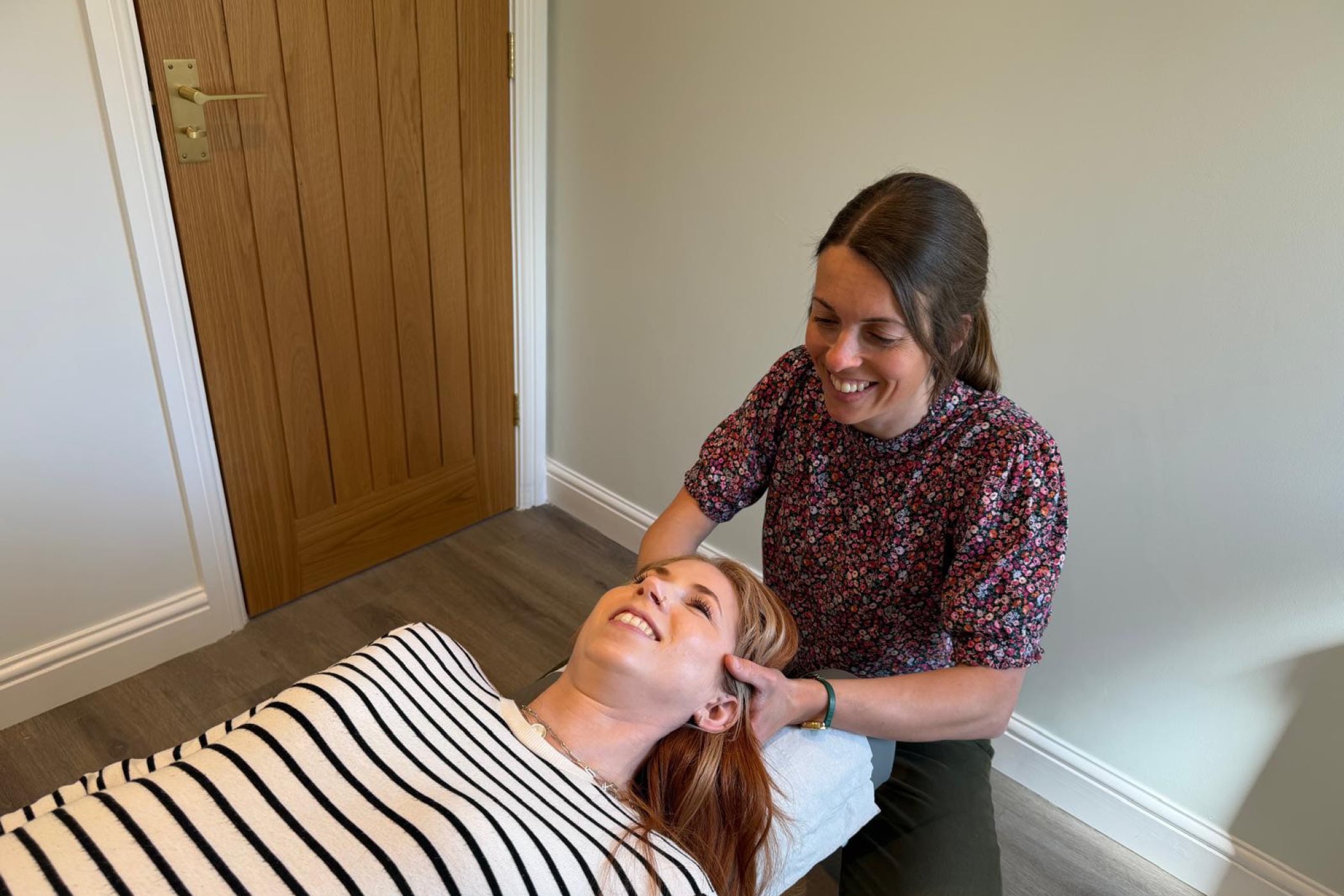
The techniques I use are hands-on and tailored to the person in front of me. Some days, that may involve more direct manual treatment known as adjustments. On others, the approach may be much gentler, involving more tonal work, always guided by what your body needs and can comfortably respond to.
So, I invite you to take a moment to check in with yourself. How is your body feeling right now? Has it been giving you any gentle nudges that something may need to change?
Often, the first step isn’t about doing more, it’s about giving yourself the space to be supported.